
Tools vs. System: Why Crucible Is the Answer the Market Has Been Missing
The stack isn't the problem. Raw recordings beat tool stacks — and Crucible is the AI content creation system and ghostwriter alternative that turns a founder's brain dump into shipped content in their own voice.
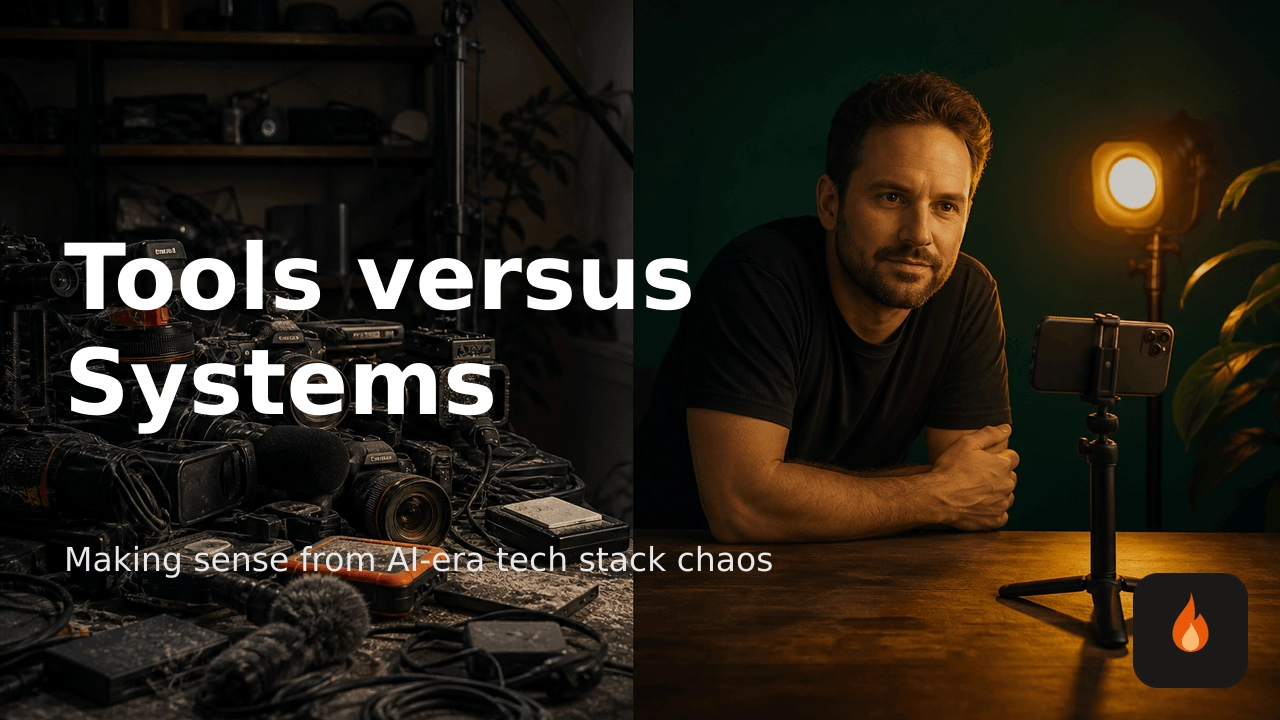
The stack isn’t the problem
At some point in building Alloy GTM, I tried just about every tool out there for brand marketing. Camtasia and DaVinci Resolve for traditional video editing. OpusClip and Descript for the easy, AI-assisted clipping and smoothing that’s supposed to make video content painless. All of them are genuinely good at what they do.
And yet none of them solved the actual problem founders have. Because the problem was never a missing feature. It was the gap between having a stack of capable tools and actually shipping a finished, authentic piece of content. That’s true for startups building a product. It’s just as true for founders building a brand.
What my first automated system got right
Before Crucible, I built one of the first versions of an automated editorial calendar system. The idea was simple: take a business’s profile, digest it into a framework, and let a founder log in, pick topics that made sense for their editorial calendar, and hit generate. Out came AI-generated posts for Facebook, Instagram, LinkedIn — whatever platform they needed.
What it got right was real. It helped founders stay on task. It helped them keep up with a content cadence they’d otherwise let slide. The topics were genuinely on-brand, because the framework digested the business profile correctly.
Where it broke down
But video wasn’t part of the construction. And the text and images, while technically correct and editable, had a distinct AI feel to them. The prompts were right. The images were prompted correctly. But you could tell. The final product was missing the individual’s voice — the specific, unrepeatable way a founder actually talks about their business.
So the system solved the process problem — staying on task, keeping up with content — while the content itself left a lot to be desired. Correct isn’t the same as authentic.
The raw recording insight
The turning point came from an unexpected place. I had clients who went on podcasts, and when I pulled their raw recordings — podcast appearances, or even just recordings of meetings we’d had — that’s where their most unfiltered, authentic messaging came out. Not the polished version. The real one.
So I started using those recordings — video or audio — as source material. Transcribing them, clipping segments, expanding talking points into full pieces: blog articles, lengthy LinkedIn posts, in one case an entire website. The raw, rambling, unscripted version of a founder talking was consistently better material than anything a topic-generation framework could produce from scratch.
Why Crucible is a system, not a tool
This is the distinction that matters: there are great tools out there. OpusClip, Descript, DaVinci — all excellent at video editing. The founders I work with are perfectly capable of using them, or of applying AI to speed up the process. The problem isn’t editing capability. The problem is that everything falls apart the moment a founder gets on camera. There’s real anxiety in just turning the camera on and starting to talk.
So Crucible was built to solve that specific bottleneck: a system for extracting thoughts out of leaders and getting their authentic voice out — processed lightly, optimized for both their personal brand and their company’s brand.
End to end, that means:
- Inspiration and research up front — making sure founders know what to focus on, since they already have the thoughts, they just need hooks to hold onto.
- Easy ways to hit record — a rambling braindump, a train of thought on a walk in the woods, or an AI-guided interview (like a podcast host asking questions) for founders who need structure to lower the anxiety.
- Processing that respects the voice — editing video down into clips, similar to what Descript or OpusClip do, but inside a workflow built specifically around extracting a founder’s real thinking.
- Output in the founder’s own voice — video clips, carousel slides, and long-form and short-form written content built from what they actually said, not a sanitized AI rewrite.
AI is part of the toolbox. But the founder’s voice, their actual face, stays front and center. That’s not replicable by AI alone, and it shouldn’t be.
Where tools like Claude still fit
Tools like Claude are genuinely useful for inspiring a founder with scripting ideas, or for taking a founder’s existing knowledge base and topics and generating direction. They can also help manipulate a transcript of what a founder actually said to fit a thirty-second clip or a LinkedIn post. Useful, but limited — because the challenge was never the individual capability of any one tool. It’s fitting all of it into a system a founder will actually use.
The takeaway
Having the best individual tools — for editing, for scripting, for scheduling — doesn’t ship your solution. Assembling them yourself, every week, is its own job on top of running your company. That’s the gap Crucible was built to close: not a smarter tool to add to the stack, but a system that takes a founder from raw, unfiltered braindump to shipped content, in their actual voice, without the anxiety of the blank screen or the dilution of a middleman.
If you’ve got the thoughts in your head already — and most founders do — the missing piece was never another tool. It’s the scaffolding to get those thoughts out and into the feed. That’s what Crucible is built to be.
Turn your next brain dump into a week of content.
Record whenever inspiration strikes. Crucible handles the rest — in your voice.
Start your first campaign free